





Amy Lazaro-Javier: ‘Eminent lady’ of the court


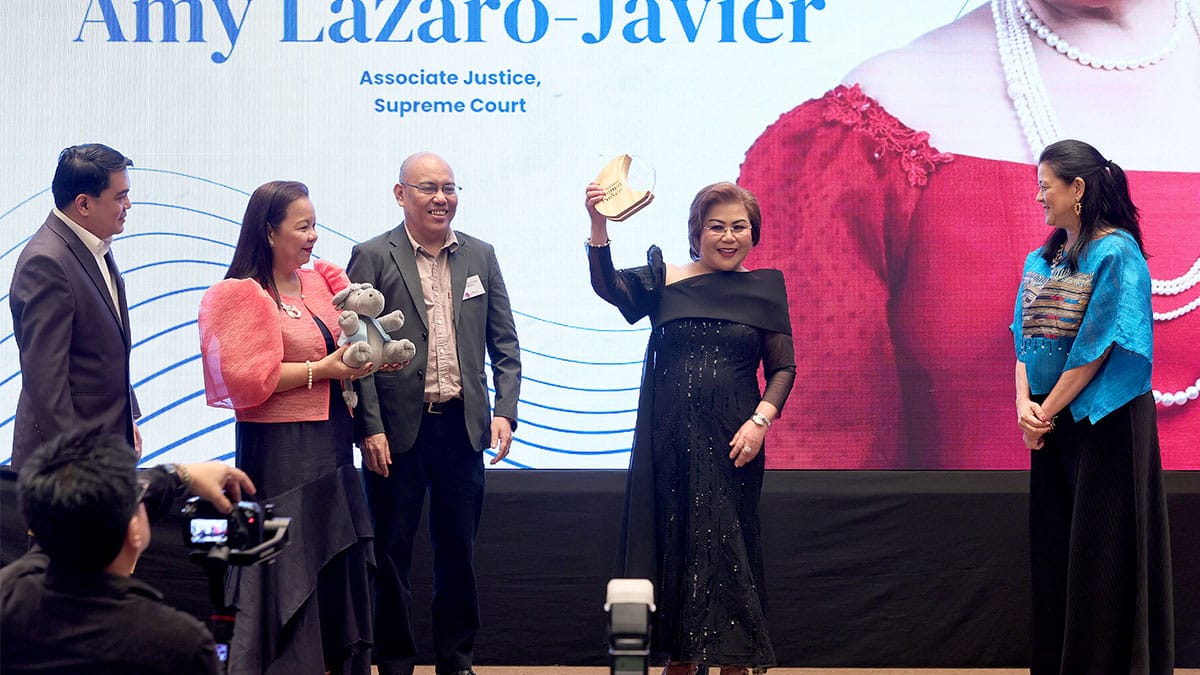
TRAILBLAZER IN JUDICIARY Supreme Court Associate Justice Amy Lazaro-Javier raises her Women of Power award as she’s joined by (from left) Inquirer president and CEO Rudyard Arbolado, associate publisher Juliet Labog-Javellana, executive editor Joseph Voltaire Contreras and Inquirer Group of Companies CEO Sandy Prieto-Romualdez during the 3rd Women of Power Awards on March 24 at the Hilton Manila in Pasay City. —Grig C. Montegrande
As a legal adage goes, the court speaks only through its judgments.
And what better way to understand the philosophy of one of the only two sitting women Supreme Court justices, Associate Justice Amy Lazaro-Javier, than by examining her “ponentes,” as well as her concurring and dissenting opinions?
Of particular interest is Lazaro-Javier’s concurring opinion on the General Register (G.R.) No. 252739, wherein the majority ruled to convict a man for violating the Anti-Violence Against Women and Their Children Act (Anti-VAWC Act) after engaging in an extramarital affair that resulted in the birth of a child with another woman.
The man claimed that the other woman was only a “onetime sexual partner,” not his mistress, and argued that the charge of “keeping a mistress” was defective, violating his right under Article III, Sec. 14(2) of the 1987 Constitution to be informed of the nature and cause of the accusation against him.
Lazaro-Javier, in her concurring opinion, did not mince words in responding to the man’s claim: “His conscious decision to desecrate his marital vow and his promise of monogamy to [his wife] cannot simply be brushed off as a simple lapse of judgment.”
In a more recent jurisprudence, people from the legal community noted the associate justice’s strong dissenting opinion on a majority ruling that held only the injured spouse and not the one who knowingly entered a bigamous marriage can petition to nullify it.
“To be abundantly clear, even unfaithful wives who cheat on their husbands are entitled to the full measure of protection of the law, as morally objectionable as their infidelity may have been,” she wrote in her 15-page dissenting opinion on G.R. No. 259520.
“This should not entitle the State or the Court to strangle her into a marriage that in law is clearly void,” she said.
From her decisions and incisive legal opinions, Lazaro-Javier has repeatedly demonstrated the exceptional intellect that earned her a seat in the nation’s highest court.
Retired Chief Justice Artemio Panganiban, upon Lazaro-Javier’s appointment six years ago, described her as an “eminent, qualified lady.”
A quick look at her resume reveals a distinguished career marked by intellectual excellence, as she graduated valedictorian (magna cum laude) at the University of Santo Tomas Faculty of Civil Law in 1982.
Before practicing law, Lazaro-Javier, a product of the public education system, served as a public schoolteacher from 1977 to 1983, teaching social studies at Lakandula High School, Ramon Magsaysay High School, and Manila Science High School.
Climbing up the legal ladder
Lazaro-Javier would later dedicate 24 years of her life to the Office of the Solicitor General, starting as a trial attorney, then advancing to solicitor, and ultimately serving as assistant solicitor general for 14 years before being appointed associate justice of the Court of Appeals.
During her 12-year tenure at the appellate court, she maintained a zero-case backlog—a testament to what Panganiban described in his 2019 Inquirer column as her “veritable reputation for integrity and industry.”
When she first applied for a position as a Supreme Court justice in 2016, Lazaro-Javier openly opposed the high tribunal’s majority decision to allow the burial of Ferdinand Marcos Sr. at the Libingan ng mga Bayani.
As one of only two women justices in the Supreme Court, Lazaro-Javier champions women’s empowerment not just through her rulings but also through her roles as president of the Philippine Women Judges Association (PWJA) and vice president of the International Association of Women Judges.
During PWJA’s annual convention on March 5, she lauded the women judges for their vital contributions to advancing gender equality in the judiciary.
She emphasized that the “adversity quotient” is a defining trait of women judges, recognizing their resilience in a profession that was once overwhelmingly male-dominated.
“So today, this adversity quotient, we recognize, is an inherent aspect of the female experience. No woman walks through life unscathed by struggles, but we choose to take it in stride and carry on. That is how I know that the accomplished women in this room have this ‘it’ factor, because the Philippine judiciary was once a male-dominated industry. Yet today, you know, we now outnumber our male counterparts,” she said.
Redefining women
Speaking at the Court’s Women’s Month kickoff event on March 3, Lazaro-Javier underscored the need to redefine “women empowerment,” stating that today’s women “are no longer mere participants in the narrative of some man’s success.”
“Women are no longer fighting for empowerment; they are embodying it,” she said.
She further proposed a new definition of the term: “The endless possibilities women create when they embrace their innate abilities to lead and change the world.”
This Women’s Month, the Inquirer honors Lazaro-Javier as one of the Women of Power awardees for her unwavering dedication to justice, her fearless advocacy of women’s rights, and her trailblazing contributions to the legal profession.


