





Would-be immigrants see hope in re-opened US border


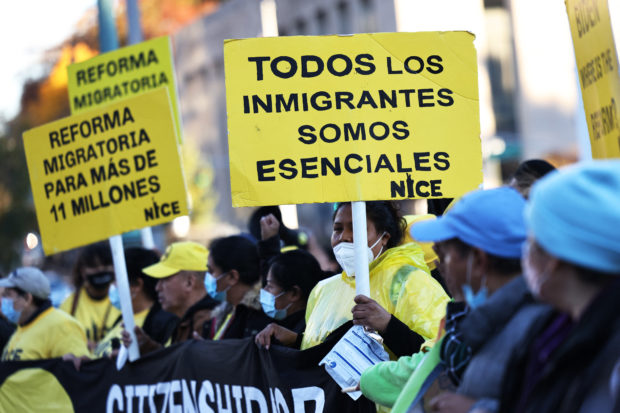
People participate in a rally calling on immigration reform at Grand Army Plaza on November 12, 2021 in the Park Slope neighborhood of Brooklyn borough in New York City. AFP
‘I would cross by river’
When the border swung open again this week, fellow resident Perez was also flooded with hope. “I was very happy,” she said. Life in a camp with no electricity is not easy, she adds, though she is hopeful her request for asylum will be granted. “But if they deny me political asylum, my thought is to cross illegally. I would even cross by river if needs be.” In the 12 months to September, the United States recorded 1.7 million people entering illegally at the southwest border, the highest figure since records began in 1960. Those illegal crossings are high, says University of San Diego School of Political Science Director David Shirk, because there is no legitimate route. “By restricting… crossing for asylum purposes, what US border policies have done is to create a very, very large and desperate population of people waiting on the Mexican side,” he said. Many are “trying to wait their turn, but finding that the length of time is too long.”‘If we wait… we get killed’
For Margarita, waiting was never an option. She and her husband Luis and their two children fled their native Bogota after being threatened by members of the FARC, Colombia’s main armed rebel group. Like other people AFP spoke to for this piece, the couple declined to give their real names. Margarita says she ruled out legal routes for migration because they would just take too long. “I said ‘if I wait to do it in 2022 or 2023, they kill us’.” They packed four suitcases and left for Mexico. In Tijuana, they followed directions until they reached a river that marks the border, which they waded into. As the water rose to their chests, they lost almost everything. “All we had left were our papers, our bible and two changes of clothes,” says Margarita, showing their belongings in two nylon sacks. US authorities took them to a detention center and separated them for three days. The couple and their five-year-old son were transferred to a migrant shelter operated by Catholic charities in San Diego to await a court hearing, while their 19-year-old daughter remained in the detention center. As Margarita was speaking to an AFP team, her daughter phoned and the two spoke for the first time in ten days. “Forgive me, forgive me,” she sobbed as she gazed at the video of her daughter on the screen. For David Shirk, the post-Covid economic boom in the United States is likely to attract more immigrants in search of work, making fixing the migration system a priority. He sees little material difference between policies pursued under President Joe Biden and those of his predecessor Donald Trump. While Biden has not talked about Trump’s border “wall”, he is nevertheless at pains not to appear soft. “It’s a kind of nuclear arms race, of… trying to show who’s tougher on border controls,” he says. “That’s not good for US immigration policy. It actually is not good for the United States and the US economy, it’s something that we absolutely need to fix, but for which there is no obvious immediate solution in sight.”
READ NEXT
EDITORS' PICK


